
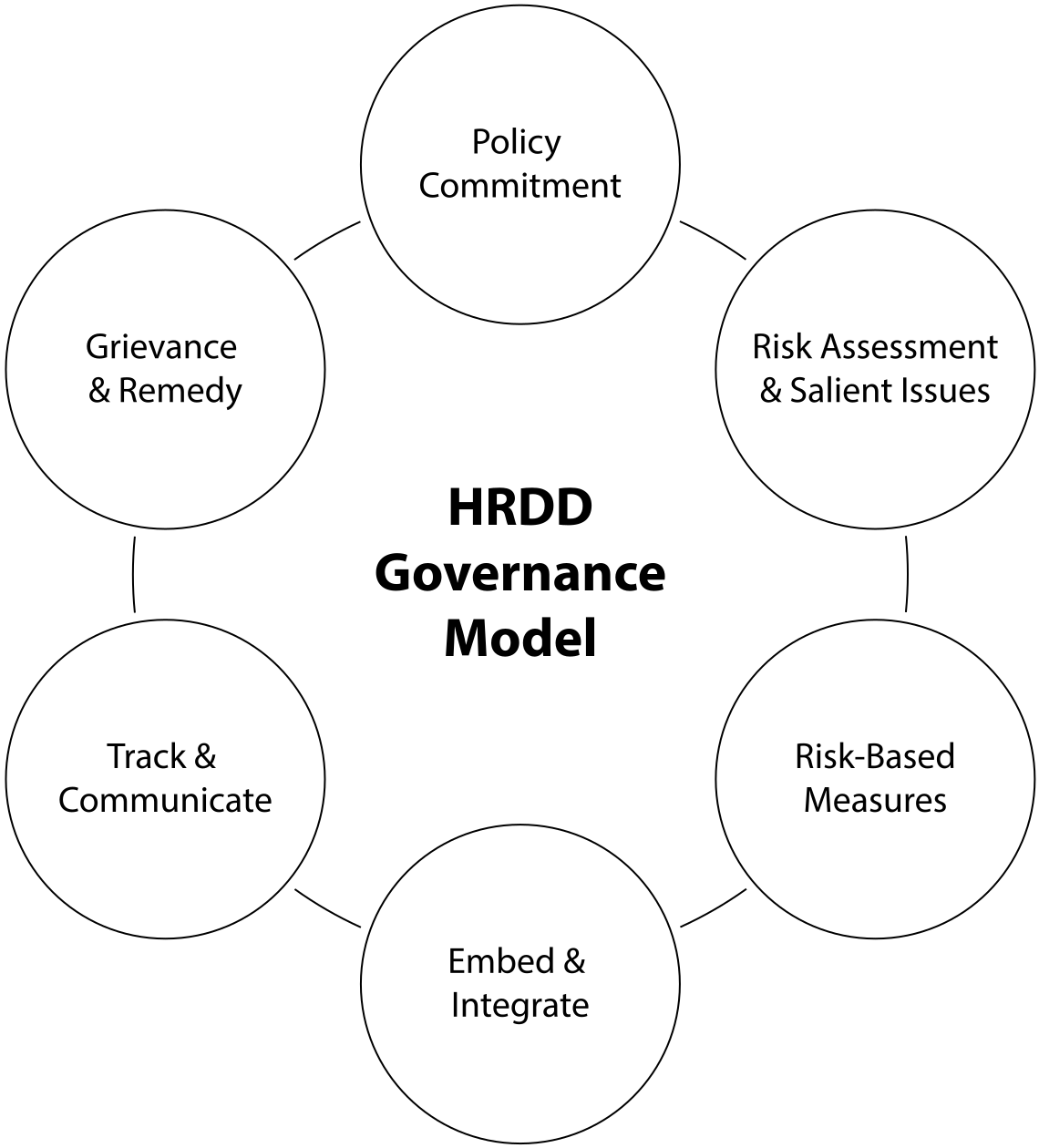
This HRDD framework encompasses the following six steps, as also covered by our Human Rights Policy:
Policy commitment
Identify, assess, and prioritize actual and potential human rights impacts
Cease, prevent, or mitigate adverse human rights impacts
Embed and integrate respect for human rights
Track and communicate performance
Access to grievance and remedy
Each of these interconnected steps is further detailed below.
1 Policy commitments
The dedicated Human Rights Policy further reinforces Datwyler's commitment to support and respect human rights and guides the implementation of the HRDD framework for the company.
Approved and signed by our Chairman and CEO, this policy is globally valid and underlies all business activities and relationships.
The Human Rights Policy has been developed by consulting different stakeholders, both internal and external, such as those participating in the different workshops that led to the identification and approval of the salient human rights issues in our value chain.
2 Identify and assess actual and potential impacts and prioritize human rights issues
Datwyler does not attribute more importance to one human right over another. Nevertheless, for the practical implementation of its human rights commitment, Datwyler focuses on the following topics (in alphabetical order), to the extent they may have adverse human rights impacts, that are the most salient to our business according to their scale, scope, and remediability:
Child labor
Consumer and product safety
Corruption
Environmental issues impacting human rights
Forced labor
Labor conditions
Occupational health and safety
The whole process of identifying, assessing and prioritizing our salient human rights issues involved the consultation of over thirty internal and external stakeholders from different sectors, functions and geographies, assessing the potential severity of each issue's impact and the company's leverage.
These salient human rights issues will be periodically re-assessed via systematic human rights risk and impact assessments conducted in accordance with the UNGPs.
Also, and despite the non-attribution of more importance to one human right over another, when it comes to children rights we commit to: (i) respect children’s right to be free from child labor, (ii) permit safe work for children above the applicable minimum age, if such work exists, and (iii) seek to follow the higher standards, where and when feasible, whenever local laws are less stringent than Datwyler’s policies and internationally recognized human rights and labor standards.
3 Cease, prevent, or mitigate adverse human rights impacts
Based on the human rights risks and impacts identified and in a continued dialog with internal and external stakeholders, Datwyler defines and implements appropriate measures to cease, prevent, or mitigate adverse human rights impacts across the value chain. An important step in this process is the adequate implementation of human rights standards across the company and the progressive embedding of these standards in different business processes.
In the next financial year we will focus on the following:
Continue progressively embedding human rights topics into our internal processes
Provide training to the organization to continue building awareness on human rights
Perform supplier risk assessment to identify those with heightened human rights risk
Perform own operations risk assessment to identify those with heightened human rights risk
Continue refining our grievance and whistleblowing channels
Take measures to cease, prevent or mitigate identified human rights risks and impacts in our own operations and supplier risk assessments
4 Embed and integrate respect for human rights
In order to further disseminate human rights-related prevention and mitigation measures, these will be, to the extent possible, progressively integrated into the company processes, training courses and documents.
Having taken the initial measures in 2023, including publication and dissemination of our Human Rights Policy, initial training and communication and update of our employee and supplier Code of Conduct, in 2024 we focused and delivered on the following:
Refining our grievance and whistleblowing channels for reporting suspected human rights violations
Conducting of our first CSR supplier audits
Promoting human rights criteria in supplier-related topics such as supplier performance monitoring, sustainable procurement guidelines, and social and environmental clauses in procurement contracts
Training for site leadership teams
In parallel, more actions were initiated and are moving forward in an orderly manner, for example embedding human rights topics in various HR processes, integration of human rights requirements into the supplier selection procedure, additional training and communication materials as well as human rights risk assessments of all operational sites and targeted suppliers.
5 Track and communicate performance
Datwyler commits to report, in its annual sustainability report, on the progress of its efforts to address the identified and prioritized human rights issues and mitigation measures.
To monitor and track the effectiveness of our defined mitigation measures, we use a management system with specific key performance indicators that allows us to have a clear view of the progress being made.
In 2024, Datwyler achieved good progress with an overview of the key performance indicators below:
Number of processes and documents in which human rights issues are included: 13 processes and documents, of which seven are completed and six are ongoing (see chapter 4)
Number of suppliers that are assessed for human rights risks: clear criteria have been defined, the risk assessment will be carried out accordingly starting in 2025
Number of sites that are assessed for human rights risks: all sites completed the risk assessment
Number of human rights due diligence training sessions: two sessions were provided to site directors and site leadership team of all locations
6 Access to grievance and remedy
Datwyler attaches great importance to living a culture of integrity and shared responsibilities. Anyone who has a legitimate concern can freely speak up, without fear of retaliation, verbally or in writing, either with the appropriate manager or via our Compliance and Whistleblowing Hotline. This whistleblowing system ensures anonymity and data protection and is available in 10 languages.
Our Code of Conduct, Human Rights Policy, and other internal documentation and training also include detailed descriptions of our reporting channels.
When adverse human rights impacts are uncovered due to Datwyler business activities or from links to its operations, the company is committed to taking timely and transparent action to remediate in a fair and equitable manner in line with the UNGPs. Where Datwyler finds impacts directly linked to its business relationships, to the extent possible, it will use its influence to encourage suppliers and business partners to respect human rights.