
4.1 Remuneration governance framework
Nomination and Compensation Committee
The Nomination and Compensation Committee generally consists of three members of the Board of Directors who are elected individually each year by the Annual General Meeting. The chair is also elected by the Annual General Meeting.
At the end of 2025, the members of the Nomination and Compensation Committee were: Hanspeter Fässler (Chairman), Jens Breu and Claude R. Cornaz. The Nomination and Compensation Committee held five standard meetings in 2025.
Meeting attendance 2025
| Hanspeter Fässler | 5/5 |
| Jens Breu | 5/5 |
| Claude Cornaz | 5/5 |
Responsibilities of the Nomination and Compensation Committee
The Articles of Association of Dätwyler Holding Inc. contain provisions on the responsibilities and duties of the Nomination and Compensation Committee. The Articles of Association are available on our website.
The Nomination and Compensation Committee also has written regulations setting out its responsibilities. The Committee generally prepares the groundwork for proposals and decision-making by the full Board. It has executive authority only within the remuneration framework already approved in principle by the Annual General Meeting or Board of Directors and where expressly provided in the Articles of Association or a set of regulations. It meets upon invitation of its chair as often as necessary, but at least once a year. The Chairman and the CEO attend the meetings by invitation and in an advisory capacity, and the HR officer of the Group takes the minutes. The CEO does not attend the discussion of the agenda items relating to his/her performance and remuneration.
Approval levels
Proposal |
Review |
Approval |
|
|---|---|---|---|
Remuneration principles (Articles of Association) |
Nomination and Compensation Committee |
Board of Directors | Annual General Meeting (binding vote) |
Remuneration models for the Board of Directors and the Executive Committee |
Nomination and Compensation Committee | Board of Directors | |
Remuneration Report |
Nomination and Compensation Committee | Board of Directors | Annual General Meeting (consultative vote) |
Maximum aggregate amount of remuneration for the Board of Directors |
Nomination and Compensation Committee | Board of Directors | Annual General Meeting (binding vote) |
Individual remuneration of Board of Directors members |
Nomination and Compensation Committee | Board of Directors | |
Maximum aggregate amount of remuneration for the Executive Committee |
Nomination and Compensation Committee | Board of Directors | Annual General Meeting (binding vote) |
Remuneration CEO |
Nomination and Compensation Committee | Board of Directors | |
Individual remuneration other members of the Executive Committee |
CEO | Nomination and Compensation Committee | Board of Directors |
Procedure for determining the remuneration system
The remuneration system is normally reviewed every three years by the Nomination and Compensation Committee and may be adjusted to reflect the evolving business environment.
The Datwyler Group’s remuneration policy is compared against common standards for similar positions at comparable companies. The process for determining the elements and levels of remuneration for the Board of Directors and Executive Committee is based on a periodic benchmarking analysis on the basis of remuneration surveys and of remuneration disclosures published by comparable companies in their annual reports.
Comparable companies are defined as international industrial companies listed on the SIX Swiss Exchange with similar geographic scope, revenue, complexity, capitalization and employee headcount, such as Accelleron, Belimo, Bossard, Bucher Industries, Dormakaba, Geberit, Georg Fischer, Landis+Gyr, Komax, OC Oerlikon, SFS, VAT and Ypsomed.
The Annual General Meeting approves the proposals of the Board of Directors concerning the maximum aggregate amount for remuneration of the Board of Directors each year for the period up to the next ordinary Annual General Meeting pursuant to Art. 21b of the Articles of Association, and of remuneration for the Executive Committee for the following fiscal year pursuant to Art. 21c of the Articles of Association.
The amount of remuneration for members of the Board of Directors is based on service on the individual committees. It is determined annually by the Nomination and Compensation Committee within the parameters of the maximum amount approved by the Annual General Meeting and in compliance with Art. 21b of the Articles of Association and presented to the Board of Directors for approval. The members of the Board of Directors have a say in the relevant Board of Directors meetings.
The Articles of Association of Dätwyler Holding Inc. contain further provisions on the principles of performance-related remuneration, the allocation of equity securities, convertible and warrant rights and pension benefits, the additional amount for remuneration of the members of the Executive Board and the approval by the Annual General Meeting of the motions of the Board of Directors regarding the remuneration of the members of the Board of Directors and the Executive Board (Art. 21a–21d). The Articles of Association are available on our website.
4.2 Structure of remuneration for the Board of Directors
The remuneration of members of the Board of Directors is determined based on the responsibility and time requirements of their function. It includes a base fee for Board membership and additional fees for special functions such as committee chairmanship and membership.
Members of the Board of Directors receive their remuneration in the form of a fixed fee in cash and a grant of bearer shares of Dätwyler Holding Inc., blocked for five years. The number of bearer shares granted is calculated from the fixed amount and the average price on 30 calendar days prior to the grant date. In the event of death or disability of a Board member, the shares may be unblocked early at the request of the participant or their beneficiaries.
Remuneration model for the members of the Board of Directors
Cash |
Blocked shares |
|
|---|---|---|
Base fee |
||
For Board membership |
30'000 | 150'000 |
Additional fee |
||
Board chair |
100'0001 |
180'0001 |
Board vice-chair |
50'000 | |
Committee chair |
40'000 | |
Committee membership |
20'000 |
There is a right to vote on the additional fee for the Board chair. Of the total amount of CHF 280'000, between CHF 150'000 and CHF 230'000 can be drawn in the form of blocked shares.
The elements and amount of the remuneration are based on benchmarking analysis with the above-mentioned group of comparable international industrial companies.
Board members may receive additional compensation for assuming special duties, as well as for participation in meetings of a temporary additional committee, provided that this is defined in advance by the Board of Directors.
Fees are paid and shares allocated in June for the current year of Board service. They are subject to regular social security contributions but are not pensionable. There is no general reimbursement for travel expenses.
4.3 Structure of remuneration for the Executive Committee
The remuneration of the Executive Committee consists of the following components:
Remuneration model for the Executive Committee
Instrument |
Purpose |
|
|---|---|---|
Fixed base salary |
Monthly cash payments | To compensate for performance of duties and for qualifications required to perform the role |
Variable bonus |
Annual cash payment | To reward collective business performance in the reporting year (selection of revenue, profit, cash flow and sustainability criteria) |
Long-term incentive plan |
Annual granting of performance share units with a vesting period of three years | To drive sustainable results and create long-term alignment with shareholders’ interests |
Employer social insurance contributions and perquisites |
Retirement pension, insurance and perquisites | To protect against risks and reimburse business expenses |
Fixed base salary
The amount of the fixed base salary depends on the scope of the position, the qualifications and experience required to perform the role and the market environment. The objective is to pay fixed salaries in line with those offered by the peer group of companies mentioned above for similar positions.
Variable bonus
The variable bonus rewards the collective performance of the company over a time horizon of one year. For the CEO, the target bonus is between 75% and 100% of the annual fixed base salary, while for the other members of the Executive Committee it is set individually at between 25% and 60% of the fixed base salary. The relevant maximum limits amount to twice the target bonus.
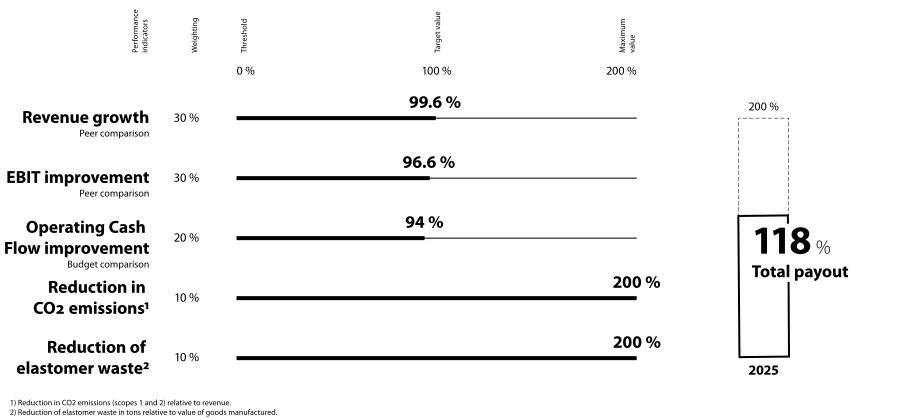
In alignment with the overall strategy of sustainable profitable growth, the variable bonus will be measured on the basis of four performance indicators with different weightings:
Net revenue growth compared to previous year, relative to a peer group of companies (weighting 30%)
EBIT improvement (earnings before interest and tax) compared to previous year, relative to the same peer group of companies (weighting 30%)
Improvement in operating cash flow relative to an internal budget figure (weighting 20%)
Sustainability measurement parameters (weighting 20%)
The comparison of the two performance indicators net revenue growth and EBIT improvement with the performance of similar companies is performed by Obermatt AG. The peer group includes companies that have a comparable base of products, technology, customers, suppliers or investors and thus are exposed to similar market cycles as Datwyler. There is a separate peer group for the Healthcare and Industrial divisions. For the members of the Executive Committee, the results of the Healthcare and Industrial divisions are weighted with their share of revenue.
Peer groups in the reporting year:
Healthcare Division peer group
Aptargroup (Pharma), Baxter, Becton Dickinson (Medical), Borosil, Corning, Gerresheimer, ICU Medical, Lonza, Medmix, Medtronic, Nipro, Sartorius, Schott Pharma, Stevanato, Terumo, West Pharmaceutical, Ypsomed
Industrial Division peer group
Amcor, Amphenol, Ball, Bridgestone, Continental (ContiTech), Cooper-Standard, Eagle Industry, Elkem, Fujikura, Hexpol, Johnson Controls, Parker-Hannifin (Diversified Industrial), Sanok, Semperit, SIG, Silgan, Sonoco, Stoneridge, Sumitomo Riko, TE Connectivity, Trelleborg, Valeo, ZF
In order to achieve the target bonus for the performance indicators of net revenue growth and EBIT improvement, the median performance of the peer group must be reached for both indicators.
The maximum payout for net revenue growth and EBIT improvement can only be achieved if Datwyler outperforms all peer companies on the respective indicator. If Datwyler performs worse than all peer companies on one indicator, there will be no payout for that performance indicator. Values between 0% and the maximum amount are calculated by linear interpolation.
The Board of Directors may adjust the performance indicators or deviate from the calculation method in special circumstances.
The measurement parameters for the sustainability performance indicator are derived from the topics covered in the double materiality analysis. They may be defined and weighted annually by the Board of Directors.
Long-term incentive plan
The long-term incentive plan measures Datwyler’s performance relative to comparable peer companies over a three-year period and is based on what are known as performance share units (PSUs). A PSU is a conditional right to receive bearer shares of the company subject to the fulfillment of certain conditions during a three-year vesting period. The vesting conditions include both the achievement of predetermined performance objectives and a non-terminated employment relationship at the end of the vesting period.
As a basis for the allocation of PSUs, the Board of Directors has determined a target amount for each member of the Executive Committee. This target amount is based on the above-mentioned peer group. The grant value of the PSUs amounts to around one-third to two-thirds of the fixed base salary of the members of the Executive Committee.
At grant date (1 January), the target amount and the average closing share price during the twenty trading days before the grant date are used to determine the respective number of PSUs. The performance conditions (weighted at one-third each) were as follows in the reporting year:
Relative net revenue growth
Relative ROCE growth
Relative total shareholder return (TSR)
Datwyler’s performance is measured annually over the three-year program period for all three indicators and compared with that of the above-mentioned peer group. The nine measurement points determined in this way show Datwyler’s performance over the three years. The peer group is confirmed by the Board of Directors prior to the annual grant of PSUs and may be adjusted if required.
The long-term incentive plan links a significant part of the Executive Committee’s remuneration to the company’s long-term performance, thus strengthening alignment with the shareholders’ interests. The payout factor is determined as follows:
Percentile rank < 25% of the peer group (threshold): 0% payout
Percentile rank at the median of the peer group: 100% payout
Percentile rank > 75% of the peer group (cap): 200% payout
Linear interpolation between these points
The combined payout factor is a weighted average of the payout factors for the three performance conditions. To determine the total number of shares vested to the participant at the end of the vesting period, the number of PSUs initially allocated is multiplied by the combined payout factor. The relative performance achievement and the combined payout factor are calculated by Obermatt AG.
If Datwyler reports a negative profit after tax (i.e. a loss) from continuous operations during the last year of the three-year vesting period, or if the Board of Directors believes that an adequate dividend cannot be paid out to shareholders, the Board of Directors reserves the right to determine whether and to what extent the PSUs for this period should be forfeited without any compensation, irrespective of the combined payout factor achieved.
In the case of departure from the company, the PSUs are usually forfeited without any compensation, except in the case of retirement, death, disability or change of control at the company. In such cases, shares are transferred to the participants on a pro-rata basis at the end of the vesting period based on the payout factor achieved; in the event of death, the pro-rata transfer already takes place at the time of death.
If Datwyler is required to prepare an accounting/financial restatement, clawback and malus provisions will apply to PSUs or shares awarded under the long-term incentive plan.
Perquisites and social security contributions
Members of the Executive Committee do not receive any particular executive benefits. They are entitled to a company car or equivalent compensation. Perquisites reflect the employer’s contribution to private use of business vehicles and child allowances. Members of the Executive Committee belong to the regular social and pension plans of the country in which their employment contracts were concluded.
4.4 Remuneration in the reporting year 2025
The remuneration to current and former members of the Board of Directors and Executive Committee and persons connected with them are presented below. Explanations are provided after the tables. Tables 1 to 8 have been audited by the statutory auditors.
Remuneration Board of Directors in 2025 (term), audited
Table 1, in CHF
Name |
Function |
Cash remuneration |
Share participation1 |
Employer social security contributions |
Total remuneration |
|---|---|---|---|---|---|
Paul Hälg |
Chairman |
130'000 | 330'085 |
26'154 |
486'239 |
Hanspeter Fässler |
Vice Chairman |
70'000 | 200'062 |
14'712 |
284'774 |
Jens Breu |
Director |
50'000 | 150'017 |
13'409 |
213'426 |
Claude R. Cornaz |
Director |
50'000 | 150'017 |
13'409 |
213'426 |
Jürg Fedier |
Director |
70'000 |
150'017 |
12'016 |
232'033 |
Britt Hendriksen |
Director |
50'000 | 150'017 |
13'060 |
213'077 |
Martin Hirzel |
Director |
50'000 | 150'017 |
13'409 |
213'426 |
Gabi Huber |
Director |
50'000 | 150'017 |
10'537 |
210'554 |
Dirk Lambrecht |
Director |
30'000 |
150'017 |
11'834 |
191'851 |
Total for Directors |
550'000 |
1'580'266 |
128'540 |
2'258'806 |
The shares were granted on 2 June 2025. The reported market value corresponds to the average share price of CHF 118.31 in the time frame from 15 April to 15 May 2025.
Remuneration Board of Directors in 2024 (term), audited
Table 2, in CHF
Name |
Function |
Cash remuneration |
Share participation1 |
Employer social security contributions |
Total remuneration |
|---|---|---|---|---|---|
Paul Hälg |
Chairman |
130'000 | 330'008 |
27'382 |
487'390 |
Hanspeter Fässler |
Vice Chairman |
70'000 | 200'016 |
15'452 |
285'468 |
Jens Breu |
Director |
50'000 | 150'103 |
13'974 |
214'077 |
Claude R. Cornaz |
Director |
50'000 | 150'103 |
13'974 |
214'077 |
Jürg Fedier |
Director |
70'000 |
150'103 |
12'582 |
232'685 |
Martin Hirzel |
Director |
50'000 | 150'103 |
13'974 |
214'077 |
Gabi Huber |
Director |
50'000 | 150'103 |
11'097 |
211'200 |
Dirk Lambrecht |
Director |
30'000 |
150'103 |
12'160 |
192'263 |
Total for Directors |
500'000 |
1'430'642 |
120'596 |
2'051'238 |
The shares were granted on 3 June 2024. The reported market value corresponds to the average share price of CHF 182.83 in the time frame from 16 April to 15 May 2024.
Remuneration Executive Committee in 2025, audited
Table 3, in CHF
Name |
Function |
Fixed base salary, gross |
Variable bonus, gross3 |
Performance share units grant value4 |
Employer social security contributions |
Perquisites |
Total remuneration |
|---|---|---|---|---|---|---|---|
Volker Cwielong1 |
CEO | 576'000 |
509'760 |
300'043 |
331'720 |
15'480 |
1'733'003 |
Total for Executive Committee2 |
2'188'585 |
1'078'214 |
927'820 |
1'135'253 |
77'432 |
5'407'304 |
Highest remuneration.
As at 31 December 2025, the Executive Committee comprised five members. For four months, the Executive Committee consisted of six members.
Estimate at the time of publication of the Annual Report.
The performance share units of the long-term incentive plan were granted on 1 January 2025 based on the Datwyler bearer share price of CHF 138.46 (average closing price for the 20 trading days prior to the grant date).
Remuneration Executive Committee in 2024, audited
Table 4, in CHF
Name |
Function |
Fixed base salary, gross |
Variable bonus, gross3 |
Performance share units4 grant value |
Employer social security contributions |
Perquisites |
Total remuneration |
|---|---|---|---|---|---|---|---|
Volker Cwielong1 |
CEO | 432'000 |
329'531 |
225'164 |
239'739 |
22'625 |
1'249'060 |
Total for Executive Committee2 |
1'801'213 |
1'099'435 |
796'975 |
1'024'345 |
171'671 |
4'893'639 |
Highest remuneration; for nine months from 1 April 2024.
As at 31 December 2024, the Executive Committee comprised five members. During the reporting year, there were a few months in which two functions were staffed by two people due to two personnel changes.
In total, the variable bonuses paid to the Executive Committee for the 2024 reporting year were CHF 158,158 lower than the estimate published in the 2024 Annual Report because the degree of target achievement was lower than expected. Social security contributions have also been adjusted accordingly.
The performance share units of the long-term incentive plan were granted on 1 January 2024 based on the Datwyler bearer share price of CHF 198.40 (average closing price for the 20 trading days prior to the grant date).
Taking into account the weighting of the four key performance indicators (net revenue growth, EBIT improvement, operating cash flow improvement and sustainability), the aggregate provisional payout factor is 118% (compared to 100.9% in the previous year). See the infographic below for details.
The actual variable incentive paid out will be published in next year’s Remuneration Report.
The total remuneration of the Board of Directors and the Executive Committee is below the maximum total remuneration figures of CHF 2.35 million/CHF 6.3 million respectively, which the shareholders approved for the 2025 fiscal year at the 2024 and 2025 Annual General Meetings. During the year under review, the entry of an additional member, Michael Höller, Chief Operating Officer (COO) and Head of the Industrial Division, led to the budgeted values being slightly exceeded in the subcategories of fixed base salary and employer social security and perquisites, which is covered by Art. 21a para. 5 of the Articles of Association.
Degree to which performance indicators used to calculate the variable bonus were met
In the case of the long-term incentive plan, the payout factor was 36% based on the results of the 2022-2024 performance period. The members of the Executive Committee serving as of 31 December 2025 were allocated 300 shares for the total of 828 PSUs granted.
Remuneration of former members of the Board of Directors and Executive Committee and related parties
No remuneration was paid to former Board of Directors or Executive Committee members either in the year under review or in the previous year, nor was any non-arm’s length remuneration paid to persons connected with current or former members of the Board of Directors or Executive Committee.
Loans and credits
No loans and/or credits were granted to current or former members of the Board and Executive Committee or related parties.
Functions of Board of Directors members in other companies, audited
Table 7. In accordance with Article 734e of the Swiss Code of Obligations. For the members of the Board of Directors serving on 31 December 2025.
As of 31 December 2024 |
As of 31 December 2025 |
||||
Paul Hälg |
|||||
Director Delegate |
Aranos AG |
x |
x |
||
Director |
Dätwyler IT Infra AG |
x |
x |
||
Director |
Sonceboz Group SA |
x |
x |
||
Hanspeter Fässler |
|||||
Director |
ANYbotics AG |
x |
x |
||
Director |
Dätwyler IT Infra AG |
x |
x |
||
Chairman |
Drone Harmony AG |
x |
x |
||
Director |
Gravis Robotics AG |
x |
x |
||
Director |
Hatebur Umformmaschinen AG |
x |
|||
Director |
So Real Digital Twins AG |
x |
|||
Jens Breu |
|||||
Director |
Dätwyler IT Infra AG |
x |
|||
Chief Executive Officer |
SFS Group AG |
stock listed |
x |
x |
|
Claude R. Cornaz |
|||||
Vice Chairman |
Cornaz AG-Holding |
x |
x |
||
Vice Chairman |
H. Goessler AG |
x |
x |
||
Chairman |
Vetropack Holding AG |
stock listed |
x |
x |
|
Jürg Fedier |
|||||
Director |
Ascom Holding AG |
stock listed |
x |
x |
|
Director |
OC Oerlikon Corporation AG |
stock listed |
x |
x |
|
Britt Hendriksen1 |
|||||
Chief Financial Officer |
Syngenta Crop Protection |
– |
x |
||
Martin Hirzel |
|||||
Director |
Bucher Industries AG |
stock listed |
x |
x |
|
Director |
IPZ Property AG |
x |
x |
||
Director |
Lantal Textiles AG |
x |
x |
||
Vice Chairman |
Ronal AG |
x |
x |
||
Chairman |
Testex AG |
x |
x |
||
Gabi Huber |
|||||
Vice Chairwoman |
UBS Switzerland AG |
x |
x |
||
Dirk Lambrecht |
|||||
Chairman |
Adval Tech Holding AG |
stock listed |
x |
||
Chairman |
Dätwyler IT Infra AG |
x |
x |
Member of the Board of Directors since the 2025 Annual General Meeting
Functions of members of the Executive Committee in other companies, audited
Table 8. In accordance with Article 734e of the Swiss Code of Obligations. For the Executive Committee members serving on 31 December 2025.
As of 31 December 2024 |
As of 31 December 2025 |
||||
Volker Cwielong |
– |
– |
|||
Judith van Walsum |
– |
– |
|||
Dirk Borghs |
Director |
Target Foods NV |
x |
x |
|
Michael Höller |
- |
- |
|||
Frank Schön |
– |
– |
4.5 Report of the statutory auditor on the Remuneration Report
